The AI Gap in Clinical Trials
Every company conducting clinical research wants to become AI-first as it relates to sample management. Copilots and coding assistants will not get them there. Read on what will.
Every pharmaceutical company wants to become AI-first
AI has moved from innovation labs to the boardroom. Executives are being asked difficult questions: What is our AI strategy? How are we becoming AI-first? Where are we investing?
The industry's response has been remarkably consistent. Organizations are deploying Microsoft Copilot, ChatGPT Enterprise, AI-powered search, medical writing assistants, coding assistants, and meeting summarization tools. These investments improve productivity and help employees accomplish familiar tasks more quickly. They are valuable investments.
But they rarely change how clinical trials operate.
A clinical trial is not a collection of documents. It is a living operational ecosystem — sponsors, CROs, central laboratories, specialty biomarker vendors, sites, logistics providers, kit manufacturers, data managers, and translational scientists. Each organization performs its own responsibilities well. The challenge is that no one continuously understands the operation as a whole.
AI-first doesn't mean using AI
Many organizations mistakenly equate becoming AI-first with adopting AI tools. Those are not the same thing.
- Using AI makes existing work faster.
- Being AI-first redesigns how work gets done.
Most AI investments today help individuals — writing protocols, summarizing meetings, searching SOPs, drafting emails, generating code. These improve productivity. They do not continuously monitor a study, detect operational risks, reconcile information across vendors, or prevent issues before they impact trial execution.
Clinical trials don't primarily suffer from a productivity problem. They suffer from an operational visibility problem.
The same category error is beginning to appear inside engineering organizations themselves. It has become common to describe a product as "AI-first" because tools such as Claude, Copilot, or Cursor were used to write the code. This is a mistake. Using an AI coding assistant to accelerate a conventional application produces a conventional application faster — the intelligence lives in the developer during the build; it does not live in the product once it is running.
Where AI should actually create value: biospecimen operations
An AI-first strategy should prioritize workflows that are cross-functional, operationally complex, data-rich, highly manual, difficult to monitor, and measurable in business impact — the areas where AI changes business outcomes, not just employee efficiency. Site operations, patient recruitment, clinical supply chain, safety surveillance, vendor oversight, and biospecimen operations all qualify. Among these, biospecimen operations stand out as one of the most practical and highest-value starting points.
Few functions inside a clinical trial involve as many independent organizations. A single sample may be collected at a site, associated with an e-Requisition, packaged into a study kit, shipped by a logistics provider, received at a central laboratory, processed into aliquots, forwarded to specialty biomarker labs, linked to assay results, reconciled against the EDC, and reviewed by sponsor data management. Every handoff introduces opportunities for inconsistency.
Yet most organizations still rely on spreadsheets, emails, periodic reconciliation exercises, and retrospective reporting to understand whether everything is progressing as expected. The result is familiar to almost every clinical operations leader:
- Missing specimens discovered weeks later
- Shipment issues identified after processing windows have closed
- Vendor file inconsistencies
- Manual reconciliation efforts consuming hundreds of hours
- Limited sponsor visibility across external partners
These are not failures of people. They are failures of operational architecture.
The industry's instinctive response has been to build another dashboard. Dashboards answer an important question: What happened? Operational AI answers a different one: What is happening right now — and what is likely to become a problem next? That distinction is profound. Instead of waiting for weekly reconciliation meetings, Operational AI continuously observes specimen collections, shipments, laboratory uploads, protocol schedules, inventory, and vendor data. It detects anomalies as they emerge, correlates events across independent systems, and prioritizes operational risks before they become study risks.
This is harder than it sounds. A true operational platform must simultaneously understand clinical protocols, visit schedules, collection windows, biospecimen types, chain of custody, vendor-specific file structures, laboratory nomenclature, shipment timelines, inventory, regulatory expectations, sponsor-specific workflows, and study amendments. It must continuously reconcile information arriving from independent organizations that were never designed to communicate with one another. This is not simply an AI problem. It is an operational systems problem.
Where SpeciGen fits
This is the architectural approach behind SpeciGen.
SpeciGen is built as an AI-native operational intelligence platform for biospecimen management — designed from the ground up to be the operational nervous system that clinical trials have been missing. SpeciGen has been built by a team which has lived through and was inspired by those challenges
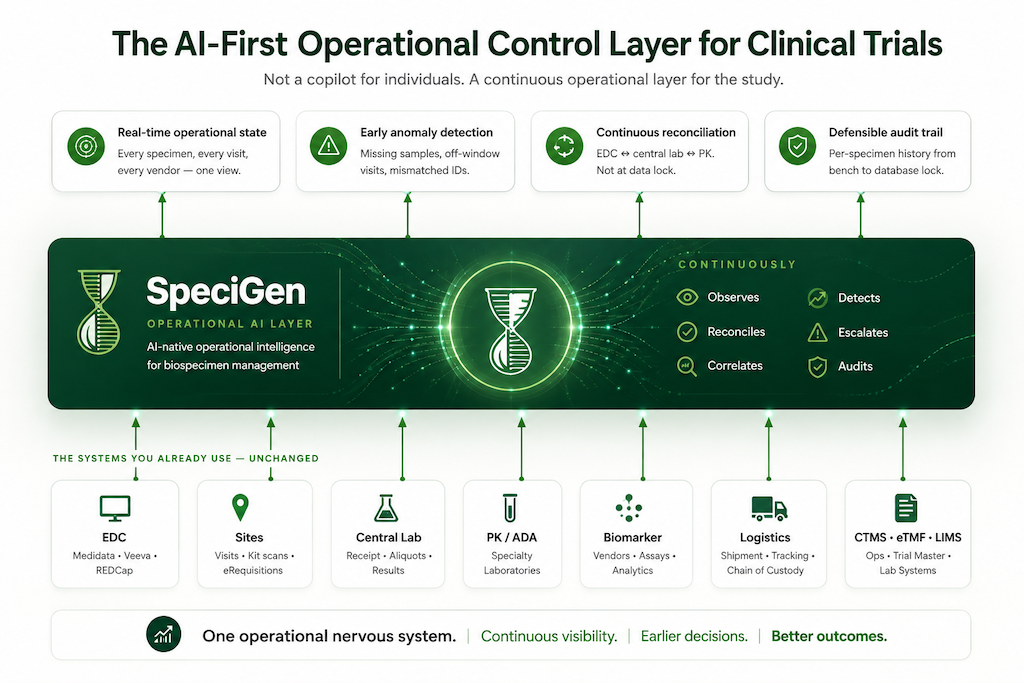
Rather than replacing EDCs, CTMS platforms, laboratory systems, or CRO workflows, SpeciGen sits above them as a unified operational layer. It continuously ingests operational signals from sites, sponsors, CROs, laboratories, logistics providers, and biomarker vendors. Using a combination of deterministic workflow rules, protocol awareness, and AI-driven anomaly detection, it continuously monitors the operational health of biospecimen workflows.
Instead of discovering issues during end-of-study reconciliation, sponsors gain near real-time visibility into specimen collections, shipments, inventory, protocol compliance, vendor discrepancies, and operational exceptions across the study.
- Manual reconciliation effort measured in weeks becomes minutes.
- Issues surface while they can still be corrected — not after data lock.
- Sponsors regain oversight across external partners without asking any of them to change platforms.
- Every specimen carries a defensible, auditable operational history — from bench to database lock.
This is what an AI-first clinical sample operation actually looks like. Not a chatbot on top of a dashboard. A system that watches the study, thinks about it continuously, and helps the humans running it stay ahead of the operation instead of behind it.